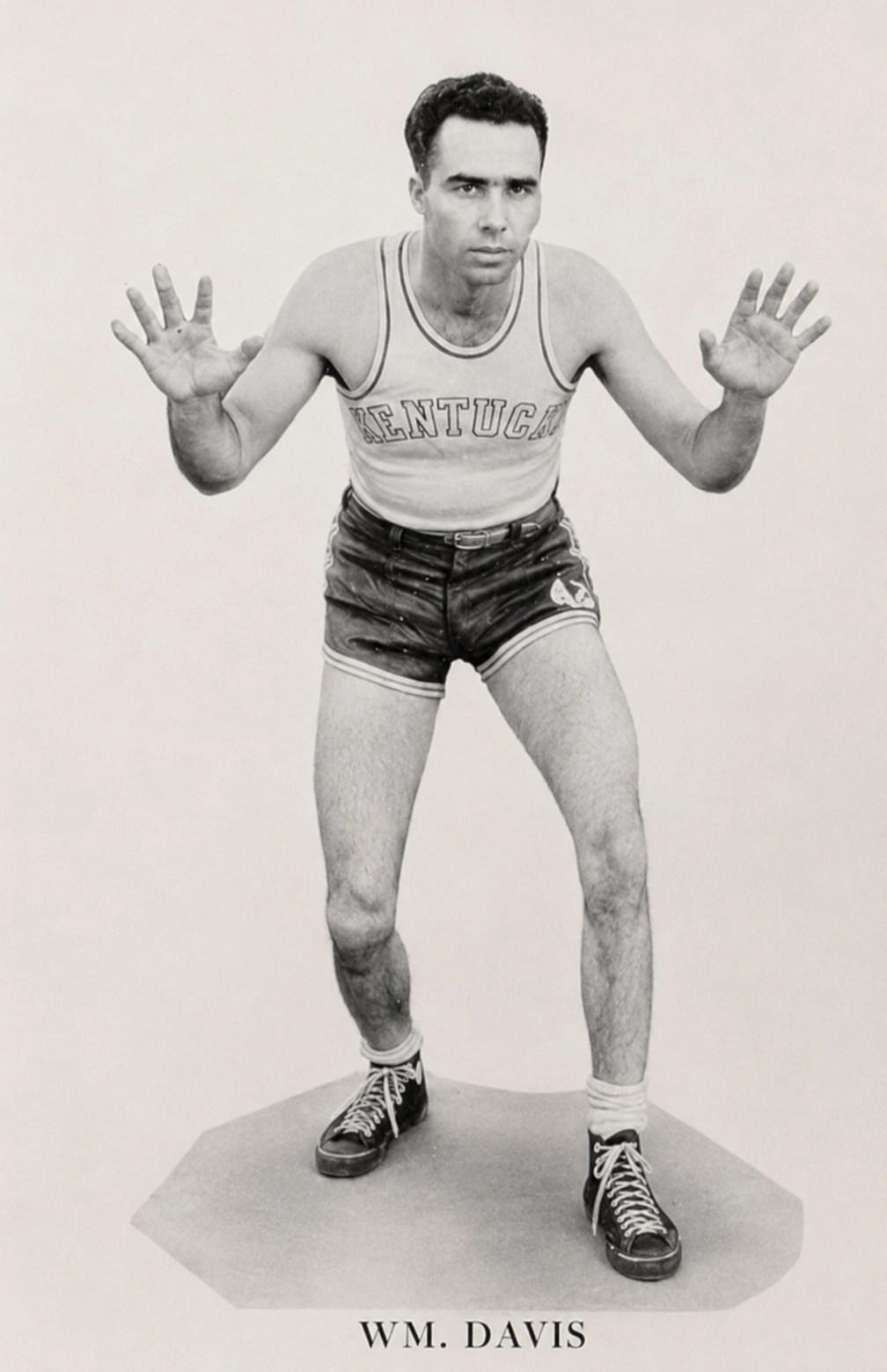
- Name
- Bill Davis
- Position
- Guard
- Class
- Junior
- Hometown (Last School)
- Hazard, KY (High)
- Ht
- 5'11"
- Seasons
- 1932-33, 1933-34
- Birthday
- January 17, 1911
Bill Davis was born William Owen Davis on June 26, 1912, in Hazard, Kentucky, to Samuel E. Davis and Dora Strong Davis. A 1929 graduate of Hazard High School, Davis quickly established himself as one of the state’s premier basketball players. He earned All-State and All-Kentucky honors, was selected to the Kentucky State Tournament All-Tournament Team, and helped Hazard become one of eastern Kentucky’s leading programs. Newspapers praised the smooth-shooting guard as one of the finest players ever to represent Hazard High, and he became known locally as both “Little Bill” and “Racehorse Bill” for his speed and relentless style of play.
Davis enrolled at the University of Kentucky in the fall of 1932 and immediately starred on Adolph Rupp’s freshman team. In an early game against Georgetown College, the Hazard native scored six field goals while outplaying veteran Wildcats, prompting one newspaper to declare that he had nearly “stolen the show.” His play quickly convinced Rupp that he would be ready for the varsity.
As a sophomore during the 1933–34 season, Davis emerged as one of the Southeastern Conference’s finest guards. Starting alongside captain John “Frenchy” DeMoisey, Ellis Johnson, Dave Lawrence, and Aggie Sale, Davis helped lead Kentucky to a 24-game winning streak before the Wildcats were upset by Florida in the conference tournament. By mid-January, he ranked fifth among Southeastern Conference scorers with 42 points in four conference games, narrowly ahead of teammate DeMoisey. He earned All-Southeastern Conference honors and developed a reputation as one of the most exciting players in the South.
Contemporary newspapers regularly celebrated Davis’ speed, defense, and tireless hustle. Writers dubbed him “Little Bill” and “Racehorse Bill,” describing him as Kentucky’s “spark plug,” “the best ball hawk in the game today,” “probably the most sensational player in the South,” and “a flash of Ole Kaintuck.” Another columnist called him “perpetual motion in the flesh,” while still another wrote that his floor work was “the fastest and best ever witnessed” on the court. During the season, Davis briefly returned home after his mother’s serious illness coincided with a fire that destroyed the Davis family home in Hazard. He soon rejoined the Wildcats and later battled a shoulder injury that limited his playing time late in the year, but when he entered a game after his absence he received a standing ovation from Kentucky fans.
Following the season, Davis played for a Kentucky All-Star team alongside DeMoisey, Aggie Sale, Leroy Edwards, Ralph Carlisle, and Houston Smith in an exhibition against a Greater Cincinnati all-star squad. One newspaper covering the game wrote that Davis was “the best ball hawk in the game today” and predicted that “his name will go down in basketball’s Hall of Fame,” adding that he was “just about the classiest all-around player ever to appear in Augusta.”
Although Davis was expected to become one of the leaders of Kentucky’s 1934–35 team, he left the university after his sophomore year. According to family members, he was disappointed after Coach Rupp selected a younger player as captain for the following season, breaking with the long-standing custom of choosing the most senior player. His brother, Roscoe Davis, later explained that homesickness played the larger role and that Bill returned to Hazard to marry his high school sweetheart, which he did. During his retirement years, Adolph Rupp often reflected that Bill Davis was the finest shooter he had ever coached.
By 1940, Davis was employed by the Columbus Mining Company. His World War II draft registration described him as standing 5 feet 9 inches tall and weighing 140 pounds. He remained closely connected to his eastern Kentucky roots throughout his life.
Bill Davis died on February 26, 1990, in Hazard, Kentucky, at the age of 77. Though his collegiate career lasted only one varsity season, his dazzling combination of speed, shooting, and defensive brilliance made him one of the most celebrated guards of Kentucky basketball’s early years and one of the forgotten stars of Adolph Rupp’s first great teams.
Statistics:
NCAA
| Season | Team | MIN | FGM | FGA | 3PM | 3PA | FTM | FTA | OR | DR | PF | AST | TO | BLK | STL | PTS | G | MPG | FG% | FT% | 3P% | RPG | APG | SPG | BPG | PPG |
|---|---|---|---|---|---|---|---|---|---|---|---|---|---|---|---|---|---|---|---|---|---|---|---|---|---|---|
| Kentucky | 0 | 63 | 0 | 0 | 0 | 26 | 29 | 0 | 0 | 21 | 0 | 0 | 0 | 0 | 157 | 24 | 0.0 | 0 | 89.66 | 0 | 0.0 | 0.0 | 0.0 | 0.0 | 6.5 | |
| Kentucky | 0 | 60 | 24 | 0 | 0 | 23 | 38 | 0 | 0 | 17 | 0 | 0 | 0 | 0 | 143 | 17 | 0.0 | 250.00 | 60.53 | 0 | 0.0 | 0.0 | 0.0 | 0.0 | 8.4 | |
| Total | - | 0 | 123 | 24 | 0 | 0 | 49 | 67 | 0 | 0 | 38 | 0 | 0 | 0 | 0 | 300 | 41 | 0.0 | 512.50 | 73.13 | 0 | 0.0 | 0.0 | 0.0 | 0.0 | 7.3 |
Career Totals
| Season | MIN | FGM | FGA | 3PM | 3PA | FTM | FTA | OR | DR | PF | AST | TO | BLK | STL | PTS | G | MPG | FG% | FT% | 3P% | RPG | APG | SPG | BPG | PPG |
|---|---|---|---|---|---|---|---|---|---|---|---|---|---|---|---|---|---|---|---|---|---|---|---|---|---|
| 1932-33 | 0 | 63 | 0 | 0 | 0 | 26 | 29 | 0 | 0 | 21 | 0 | 0 | 0 | 0 | 157 | 24 | 0.0 | 0 | 89.66 | 0 | 0.0 | 0.0 | 0.0 | 0.0 | 6.5 |
| 1933-34 | 0 | 60 | 24 | 0 | 0 | 23 | 38 | 0 | 0 | 17 | 0 | 0 | 0 | 0 | 143 | 17 | 0.0 | 250.00 | 60.53 | 0 | 0.0 | 0.0 | 0.0 | 0.0 | 8.4 |
| Total | 0 | 123 | 24 | 0 | 0 | 49 | 67 | 0 | 0 | 38 | 0 | 0 | 0 | 0 | 300 | 41 | 0.0 | 512.50 | 73.13 | 0 | 0.0 | 0.0 | 0.0 | 0.0 | 7.3 |
Photos: