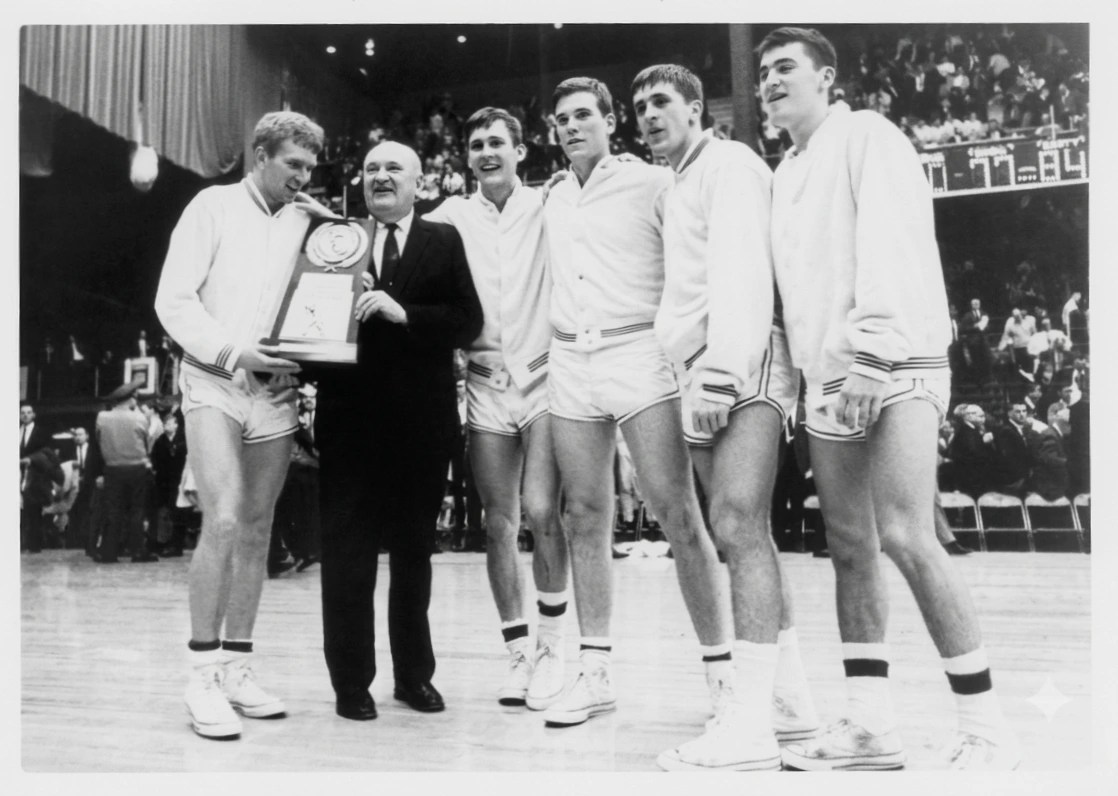
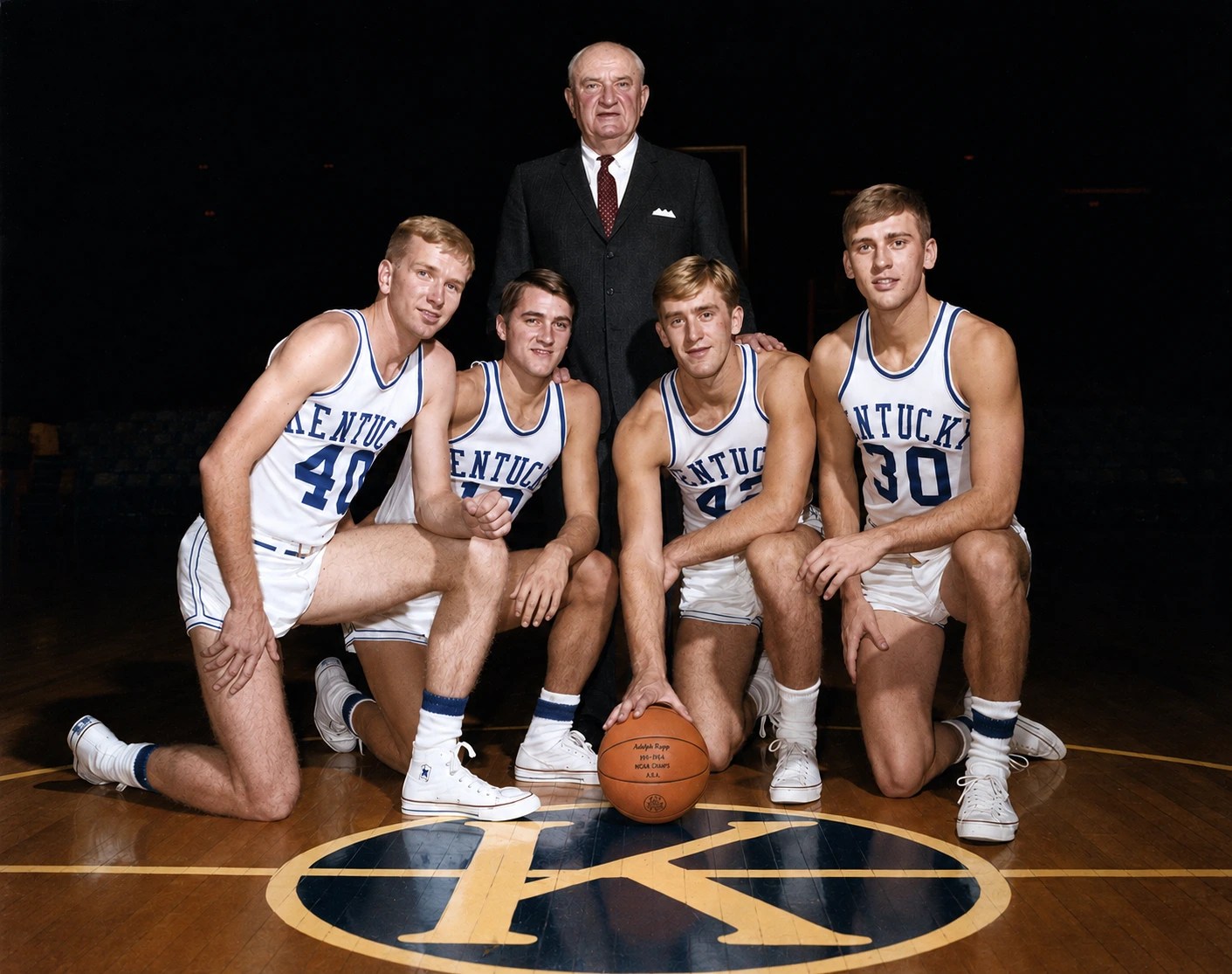
Kentucky’s 1965–66 basketball team became known as Rupp’s Runts, an affectionate nickname inspired by a starting lineup that did not include a player taller than 6-foot-5. What the Wildcats lacked in height, they overcame with experience, speed, passing, outside shooting and an exceptional understanding of Adolph Rupp’s system.
The Runts compiled a 27–2 record, won the Southeastern Conference championship and advanced to the NCAA championship game. Although their season ended one victory short of a national title, they became one of the most admired and enduring teams in Kentucky basketball history.
1965–66 Season at a Glance
| Category | Result |
|---|---|
| Head coach | Adolph Rupp |
| Overall record | 27–2 |
| SEC record | 15–1 |
| Conference finish | SEC champions |
| NCAA Tournament finish | National runner-up |
| Home arena | Memorial Coliseum |
| Leading scorer | Louie Dampier |
| Team nickname | Rupp’s Runts |
View the complete 1965–66 Kentucky schedule and results
View the 1965–66 Kentucky roster
View the 1965–66 season statistics
An Undersized but Experienced Lineup
The tallest players in Kentucky’s regular starting lineup were 6-foot-5 guard Tommy Kron and 6-foot-5 center Thad Jaracz. Forwards Larry Conley and Pat Riley each stood 6-foot-4, while guard Louie Dampier was 6-foot.
| Player | Position | Height |
|---|---|---|
| Louie Dampier | Guard | 6-0 |
| Tommy Kron | Guard | 6-5 |
| Larry Conley | Forward | 6-4 |
| Pat Riley | Forward | 6-4 |
| Thad Jaracz | Center | 6-5 |
The lineup was small even by the standards of the 1960s, particularly for a program expected to compete against the country’s strongest teams. Kentucky compensated by playing with intelligence and precision. The Wildcats moved the ball quickly, spread the floor and relied on accurate shooting rather than overpowering opponents close to the basket.
The players also possessed the experience needed to execute Rupp’s demanding style. Dampier, Kron, Conley and Riley were returning starters, while Jaracz had worked his way into the lineup and provided the strength and rebounding Kentucky needed in the middle.
Before the season, Rupp expressed confidence in the group.
“I honestly believe that man-for-man we just might have in the making a better team than we had in 1958, when we won the national championship.”
The Wildcats spent the next several months justifying their coach’s optimism.
The Stars of Rupp’s Runts
Louie Dampier supplied Kentucky with scoring, ball handling and leadership from the backcourt. One of the finest shooters in program history, Dampier led the Wildcats offensively and earned consensus All-America recognition. His ability to score from the perimeter was especially important to a team without a traditional towering center.
Pat Riley brought intensity, athleticism and toughness to the lineup. Riley could score, rebound and defend despite frequently matching up against taller opponents. He later became one of basketball’s most successful professional coaches and executives, but his place in Kentucky history had already been secured as a central member of the Runts.
Larry Conley was the team’s versatile floor leader. He could score when needed, but his passing and decision-making were equally valuable. Conley led the Wildcats in assists and helped create scoring opportunities for Dampier, Riley and the rest of the lineup.
Tommy Kron, the tallest member of the backcourt, gave Kentucky additional size, experience and defensive versatility. He was an important scorer and distributor who could perform several roles within Rupp’s system.
Thad Jaracz supplied the physical presence inside. At 6-foot-5, he routinely battled much taller centers but used his strength, positioning and determination to compete for rebounds and defend the basket.
Together, the five starters formed a balanced and cohesive unit. Each player understood his role, and Kentucky rarely needed one individual to carry the team alone.
A Championship Season
Kentucky established itself as one of the nation’s leading teams early in the 1965–66 season. The Wildcats won their first 13 games before suffering their only regular-season defeat, a 69–62 loss at Tennessee.
Rather than disrupting the season, the loss became a brief interruption in an otherwise remarkable run. Kentucky responded by winning the remainder of its regular-season games and completed conference play with a 15–1 record.
The Wildcats captured the SEC championship and entered the NCAA Tournament with a 23–1 record. Their combination of experience and disciplined team basketball made them a serious national championship contender despite their lack of height.
Kentucky opened NCAA Tournament play by defeating Dayton and then faced Michigan in the Mideast Regional championship game at Iowa City. The Wolverines featured 6-foot-7 All-American Cazzie Russell, one of the most celebrated players in college basketball.
The smaller Wildcats were not intimidated. Kentucky defeated Michigan, 84–77, to earn a trip to the Final Four.
View the Kentucky–Michigan game
The Final Four
In the national semifinal at Cole Field House in College Park, Maryland, Kentucky faced Duke. The Blue Devils entered the game with a talented and experienced team of their own, but the Wildcats advanced with an 83–79 victory.
The win improved Kentucky’s record to 27–1 and sent the Wildcats to the NCAA championship game for the first time since their 1958 title season.
Waiting in the championship game was Texas Western, now known as UTEP. Coach Don Haskins’ Miners were a powerful defensive team whose starting lineup featured five Black players. The matchup would become one of the most historically significant games in college basketball.
Texas Western held Kentucky to 38-percent shooting and forced the Wildcats into costly turnovers. Dampier and Riley each scored 19 points, but the Miners maintained control and defeated Kentucky, 72–65.
View the Kentucky–Texas Western game
The loss ended Kentucky’s season at 27–2. Texas Western claimed the national championship, while the Wildcats returned home as NCAA runners-up.
A Lasting Kentucky Legacy
The 1966 championship game became a landmark moment in the history of college basketball and American sports. Its broader historical importance has often defined how the season is remembered nationally.
Within Kentucky basketball history, however, the story of Rupp’s Runts extends far beyond that one game.
They were an undersized team that won 27 games, captured the SEC championship, defeated Michigan and Duke in the NCAA Tournament and came within one victory of a national title. Their success was built on experience, unselfish play, disciplined execution and the ability to overcome a physical disadvantage nearly every time they stepped onto the court.
The team also included several men who remained closely associated with basketball for decades. Dampier became a star in the American Basketball Association and was later inducted into the Naismith Memorial Basketball Hall of Fame. Riley built a championship legacy as an NBA coach and executive. Conley became a respected national television analyst, and the other members of the team remained beloved figures among Kentucky fans.
During the 1990–91 season, Kentucky honored the Runts on the silver anniversary of their NCAA runner-up finish. The team has also been remembered during later reunions and anniversary celebrations.
More than half a century after their remarkable season, Rupp’s Runts remain one of the most distinctive teams in Kentucky basketball history. Their nickname began as a reference to their lack of size, but it ultimately came to represent a group whose skill, toughness and teamwork made them much greater than the sum of their measurements.
Photo Gallery