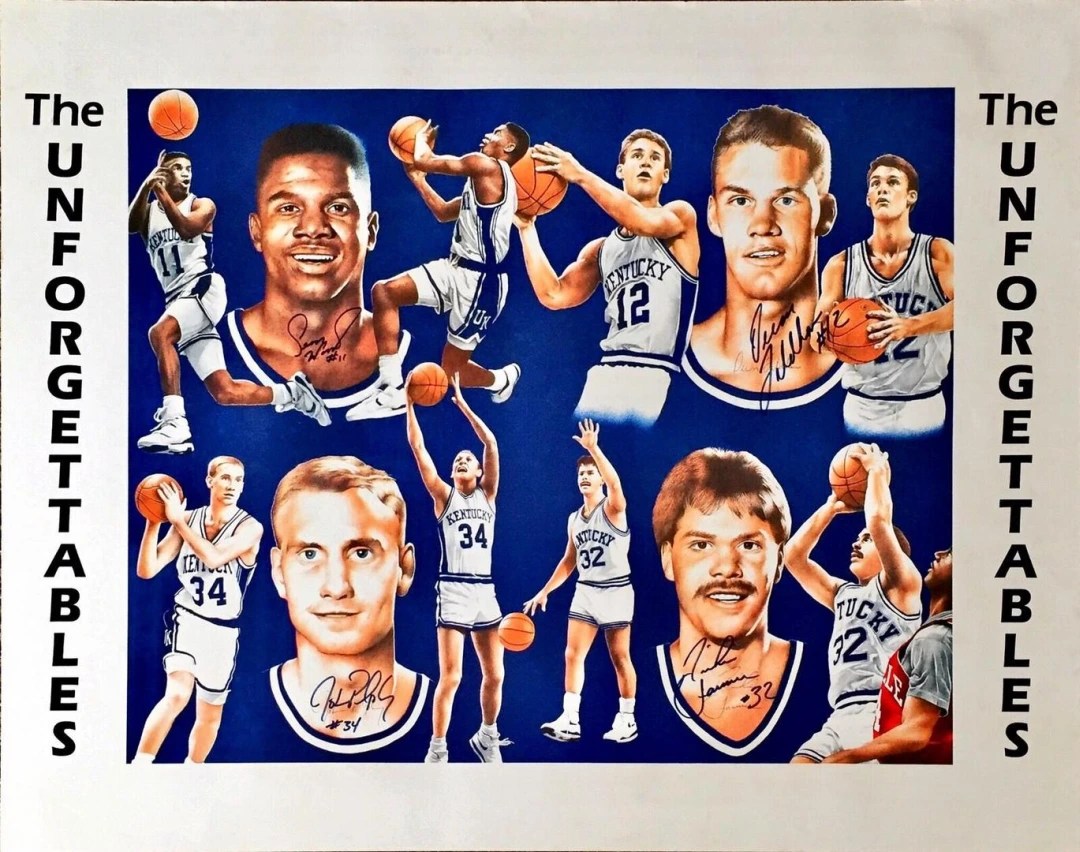
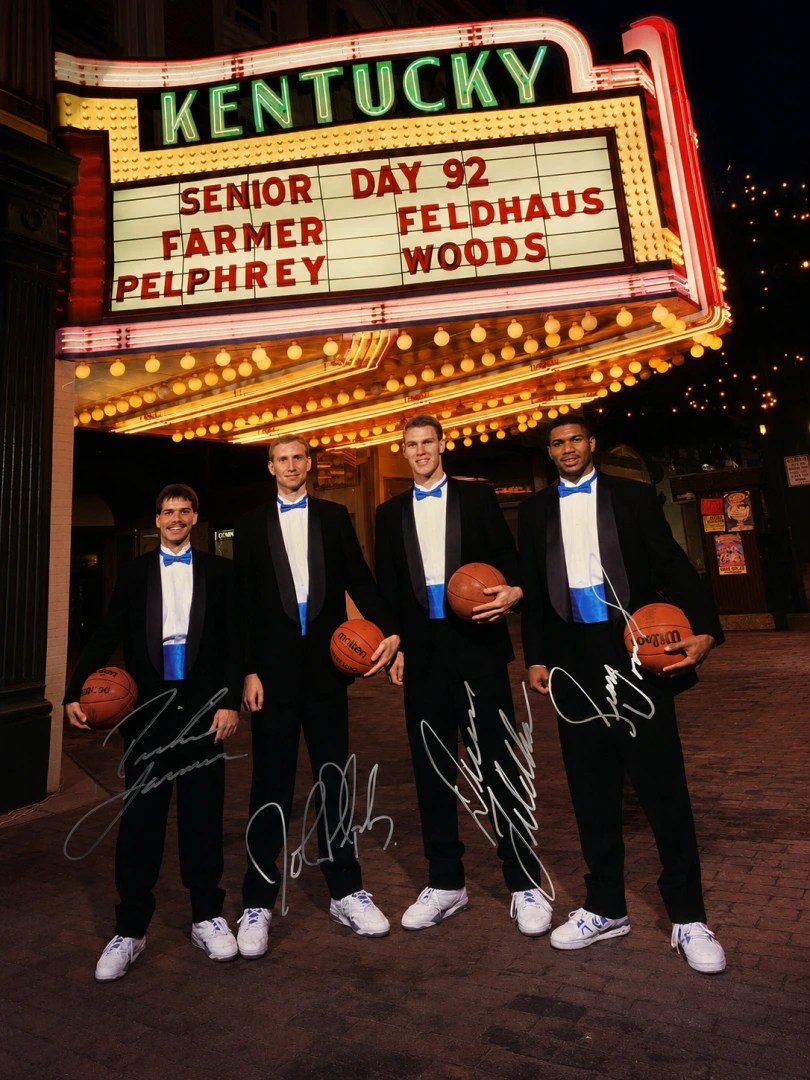
Kentucky’s Unforgettables—Richie Farmer, Deron Feldhaus, John Pelphrey and Sean Woods—became symbols of loyalty, perseverance and the restoration of Kentucky basketball. The four seniors remained with the program through one of its most difficult periods and helped return the Wildcats to national prominence during the 1991–92 season.
Led by head coach Rick Pitino and sophomore All-American Jamal Mashburn, Kentucky finished 29–7, won the Southeastern Conference Tournament and advanced to the NCAA East Regional championship game. The season ended with a heartbreaking 104–103 overtime loss to defending national champion Duke in a game widely remembered as one of the greatest ever played.
The Unforgettables did not win a national championship, but their importance cannot be measured by a trophy. They helped carry Kentucky through probation, reconnected the program with its supporters and laid the foundation for the championship teams that followed.
The Unforgettables
| Player | Position | Hometown | Jersey |
|---|---|---|---|
| Richie Farmer | Guard | Manchester, Kentucky | 32 |
| Deron Feldhaus | Forward | Maysville, Kentucky | 12 |
| John Pelphrey | Forward | Paintsville, Kentucky | 34 |
| Sean Woods | Guard | Indianapolis, Indiana | 11 |
Three of the four were Kentucky natives who had grown up understanding the importance of Wildcat basketball throughout the Commonwealth. Woods, an Indianapolis native who transferred to Kentucky, embraced that same connection and became an essential part of the group.
Their individual statistics varied, but their shared identity came from something larger. They stayed, endured and helped rebuild.
Richie Farmer
Richie Farmer arrived at Kentucky as one of the most celebrated high school players in state history. A prolific scorer at Clay County High School, Farmer had led the Tigers to the 1987 state championship game and finished his prep career among Kentucky’s all-time leading scorers.
At Kentucky, the 6-foot guard became a fan favorite whose popularity extended far beyond his role in the starting lineup. Farmer played with energy, fearlessness and the confidence expected of a player who had spent much of his life carrying the hopes of a hometown and region.
He supplied valuable perimeter shooting during the 1991–92 season and produced one of his finest performances in Kentucky’s NCAA Tournament victory over Iowa State. His willingness to accept changing responsibilities reflected the unselfish character that came to define the Unforgettables.
Deron Feldhaus
Deron Feldhaus provided strength, versatility and a distinctive offensive style at forward. The Maysville native became known for his ability to score near the basket with an assortment of unconventional moves, including a twisting reverse shot that fans came to call the “Feldhaus Flip.”
At 6-foot-7, Feldhaus could battle larger opponents inside while also operating away from the basket. He became an important scorer and rebounder during Kentucky’s rebuilding years and gave Pitino an experienced frontcourt player who understood the demands of the program.
Feldhaus was also one of Kentucky’s emotional leaders. His toughness and willingness to perform physical work around the basket made him especially valuable during the Wildcats’ postseason run.
John Pelphrey
John Pelphrey brought intensity, leadership and an unmistakable connection to Kentucky basketball. The Paintsville native had grown up dreaming of playing for the Wildcats and became one of the program’s most visible representatives during a turbulent period.
Pelphrey was a versatile forward who could score from the perimeter, rebound and defend several positions. He embraced Pitino’s conditioning program and pressure-oriented system, becoming a dependable presence at both ends of the floor.
His greatest contribution, however, may have been his leadership. Pelphrey understood what Kentucky basketball meant to its supporters and helped maintain the program’s identity while the Wildcats were barred from postseason competition.
Sean Woods
Sean Woods joined Kentucky after beginning his college career elsewhere and quickly became the Wildcats’ floor leader. The Indianapolis native directed Pitino’s fast-paced offense and supplied quickness, passing and defensive pressure from the point guard position.
Woods was an emotional competitor who played with confidence in the most demanding situations. His speed allowed Kentucky to attack before defenses could become organized, while his ball handling helped create scoring opportunities for Mashburn and the Wildcats’ veteran forwards.
He delivered the most dramatic basket of Kentucky’s 1992 postseason. With 2.1 seconds remaining in overtime against Duke, Woods banked in a running shot over Christian Laettner to give Kentucky a 103–102 lead. For one extraordinary moment, the basket appeared to have sent the Wildcats to the Final Four.
The 1991–92 Season at a Glance
| Category | Result |
| Head coach | Rick Pitino |
| Overall record | 29–7 |
| SEC record | 12–4 |
| SEC finish | Eastern Division champions |
| SEC Tournament | Champions |
| Final AP ranking | No. 6 |
| NCAA Tournament seed | No. 2, East Region |
| NCAA Tournament finish | East Regional finalist |
| Home arena | Rupp Arena |
View the complete 1991–92 Kentucky schedule and results
View the 1991–92 Kentucky roster
View the 1991–92 season statistics
Kentucky Basketball on Probation
The Unforgettables arrived or developed during one of the darkest periods in Kentucky basketball history.
The NCAA placed the program on probation in 1989 and prohibited Kentucky from appearing in the 1990 and 1991 postseasons. Scholarship reductions and recruiting restrictions complicated the rebuilding process, while national criticism damaged the reputation of a program long associated with basketball excellence.
Rick Pitino became Kentucky’s head coach before the 1989–90 season and inherited the task of rebuilding both the roster and the program’s credibility. His first team finished 14–14 as the Wildcats adjusted to an exhausting style based on conditioning, full-court pressure and frequent 3-point shooting.
The players could have sought opportunities elsewhere. Instead, the future Unforgettables remained and accepted the challenge of helping Kentucky recover.
The Boys Who Stayed
Kentucky’s circumstances made patience difficult.
The Wildcats could compete during the regular season, but their years ended without the SEC Tournament or NCAA Tournament. There would be no postseason reward regardless of how much they improved.
The players nevertheless continued working within Pitino’s demanding system. Their improvement became evident during the 1990–91 season, when Kentucky finished 22–6 and went unbeaten at Rupp Arena despite remaining ineligible for postseason play.
That team, often remembered as part of Kentucky’s “Pitino’s Bombinos” era because of its reliance on 3-point shooting, restored excitement to the program. Farmer, Feldhaus and Pelphrey were joined by Woods and freshman Jamal Mashburn, giving Kentucky a combination of experience and emerging star power.
The Wildcats could not participate in March, but they had made it clear that Kentucky basketball was returning.
Back in the Postseason
The 1991–92 season marked Kentucky’s return to postseason eligibility.
Expectations rose immediately. The veteran seniors finally had an opportunity to compete for championships, while Mashburn had developed into one of the finest players in college basketball.
Kentucky opened the season with four consecutive victories before losing to Pittsburgh. The Wildcats experienced other setbacks during the winter, including two losses to Arkansas, which was then in its first season as a member of the SEC.
Despite those defeats, Kentucky remained among the country’s strongest teams. Pitino’s pressure defense, up-tempo offense and aggressive 3-point shooting presented opponents with a style that was difficult to prepare for.
The four seniors supplied the maturity Kentucky needed, while Mashburn became the team’s leading scorer and primary offensive threat.
Senior Day at Rupp Arena
Kentucky concluded the regular season against Tennessee at Rupp Arena on March 7, 1992.
The game carried particular significance for Farmer, Feldhaus, Pelphrey and Woods. After enduring two seasons without postseason opportunities, they were finally completing a regular season that would continue into March.
Kentucky defeated Tennessee, 99–88, extending the program’s Senior Day winning streak and sending the four seniors into the postseason with a victory.
The afternoon became a celebration not merely of four playing careers, but of the loyalty they had shown during the program’s years of uncertainty.
View the Kentucky–Tennessee Senior Day game
SEC Tournament Champions
Kentucky entered the SEC Tournament in Birmingham determined to make the most of its return to postseason play.
The Wildcats defeated Vanderbilt in the quarterfinals and then advanced past LSU in the semifinal round. That victory created another meeting with Alabama, which had beaten Kentucky during the regular season.
Kentucky defeated the Crimson Tide, 80–54, in the championship game, dominating the second half to capture the program’s first SEC Tournament title since 1988.
The victory represented more than another conference championship. For the seniors who had watched two postseasons pass without them, cutting down the nets offered tangible proof that their patience and commitment had been rewarded.
Kentucky’s Return to the NCAA Tournament
Kentucky received the No. 2 seed in the East Region of the NCAA Tournament.
The Wildcats opened against Old Dominion in Worcester, Massachusetts. Kentucky won, 88–69, earning the program’s first NCAA Tournament victory in four years.
View the Kentucky–Old Dominion game
In the second round, Kentucky faced Iowa State. The Cyclones challenged the Wildcats offensively, but Kentucky advanced with a 106–98 victory.
View the Kentucky–Iowa State game
The two wins sent Kentucky to the East Regional at the Spectrum in Philadelphia. There, the Wildcats met third-seeded Massachusetts, coached by future Kentucky head coach John Calipari.
Kentucky defeated Massachusetts, 87–77, moving within one victory of the Final Four.
View the Kentucky–Massachusetts game
After years without postseason basketball, the Unforgettables had helped carry Kentucky to the Elite Eight.
Kentucky and Duke
Kentucky’s opponent in the East Regional championship game was Duke, the defending national champion and the No. 1 team in the country.
The Blue Devils featured Christian Laettner, Grant Hill and Bobby Hurley and were attempting to win a second consecutive NCAA championship. Duke entered the game as the favorite, but Kentucky matched the Blue Devils from the opening minutes.
Duke led, 50–45, at halftime. Kentucky continued to battle after the break, repeatedly answering whenever the Blue Devils appeared ready to gain control.
Mashburn eventually fouled out, forcing the Wildcats to complete the game without their leading scorer. The seniors and their teammates nevertheless kept Kentucky within reach.
The score was tied at 93 at the end of regulation.
The Greatest Game Ever Lost
The five-minute overtime period became one of the most dramatic stretches in NCAA Tournament history.
Neither team could create meaningful separation. Kentucky and Duke traded baskets as the clock moved toward the final seconds.
With Duke leading 102–101, Kentucky called timeout and prepared what could have been its final possession. Woods took the ball and drove toward the basket. His high, running bank shot dropped through the net with 2.1 seconds remaining, giving Kentucky a 103–102 lead.
The Wildcats appeared to be headed to the Final Four.
After a Duke timeout, Grant Hill stood along the baseline and threw a pass nearly the full length of the court. Laettner caught it near the opposite free-throw line, took one dribble, turned and made a jumper as time expired.
Duke won, 104–103.
View the Kentucky–Duke East Regional championship game
Laettner completed the game without missing a shot, making all 10 of his field-goal attempts and all 10 of his free throws. Duke went on to win the national championship.
For Kentucky, the defeat was crushing. Yet the performance transformed the Wildcats from a recovering program into a team admired throughout college basketball.
The contest became known among Kentucky supporters as the greatest game ever lost.
More Than One Final Shot
The final seconds in Philadelphia became inseparable from the story of the Unforgettables, but their legacy should not be reduced to Laettner’s shot.
The four seniors had remained with Kentucky while the program faced probation, postseason bans and national embarrassment. They helped improve the Wildcats from 14–14 in Pitino’s first season to 22–6 in 1990–91 and 29–7 in their final year.
They won an SEC Tournament championship, reached the Elite Eight and pushed the defending national champions to the final second of overtime.
Most importantly, they helped restore pride in Kentucky basketball.
The Wildcats who followed inherited a program that was again nationally relevant. Kentucky reached the Final Four in 1993 and won the NCAA title in 1996 under Pitino.
The Unforgettables helped build the bridge between probation and those championship seasons.
Retired Jerseys
Kentucky later retired the jerseys of all four Unforgettables:
- Richie Farmer — No. 32
- Deron Feldhaus — No. 12
- John Pelphrey — No. 34
- Sean Woods — No. 11
Their jerseys hang in the Rupp Arena rafters as a collective tribute to their loyalty and their role in restoring the program.
The honor was unusual because it recognized more than individual statistics or national awards. The four were celebrated together for what they represented during a defining period in Kentucky basketball history.
Their numbers have remained available for later players, but the jerseys honor Farmer, Feldhaus, Pelphrey and Woods permanently.
A Commonwealth Celebration
Following the season, the Unforgettables were greeted throughout Kentucky as heroes.
Their connection with supporters had grown during the probation years, when the players became the public face of a program fighting to recover. The emotional NCAA Tournament run deepened that bond.
Although their season had ended with a loss, fans understood what the team had accomplished. The seniors had represented Kentucky with resilience and had returned the Wildcats to the center of the college basketball world.
That affection endured long after their playing careers ended. Reunions and anniversary celebrations continued to draw attention, while memories of the 1992 team were passed to generations of Kentucky fans who had not seen the games themselves.
The Supporting Cast
The Unforgettables were the emotional heart of the team, but Kentucky’s success required contributions from the complete roster.
[Jamal Mashburn] was the Wildcats’ leading player and one of the country’s most difficult offensive matchups. The 6-foot-8 sophomore could score inside, shoot from the perimeter and handle the ball like a guard. His arrival accelerated Kentucky’s return to national prominence.
Other important contributors included:
Pitino’s staff also played an essential role in the rebuild. Assistant coaches Herb Sendek, Billy Donovan and Bernadette Locke-Mattox helped install the conditioning, pressure defense and offensive system that reshaped Kentucky basketball.
Cawood Ledford’s Final Season
The 1991–92 season also marked the conclusion of Cawood Ledford’s legendary career as the radio Voice of the Wildcats.
Ledford had described Kentucky basketball for nearly four decades and had called some of the greatest games in program history. His final broadcast came during the overtime loss to Duke in Philadelphia.
His retirement gave the season another emotional connection to Kentucky’s past. As the four seniors completed their playing careers, the voice that had accompanied generations of Wildcat fans also stepped away.
Ledford’s jersey later became the first retired by Kentucky in honor of someone other than a player or coach.
Their Lasting Legacy
Kentucky has celebrated teams that finished undefeated, won national championships and produced some of the greatest players in college basketball history.
The Unforgettables earned their place among those teams without accomplishing any of those things.
Their distinction came from loyalty. They remained when leaving would have been understandable. They represented Kentucky when the program’s reputation had been damaged. They accepted Pitino’s demanding rebuilding process and helped return the Wildcats to postseason basketball.
Their final game ended in defeat, but the performance embodied everything supporters had come to admire about them. They competed against the defending national champions without fear, overcame the loss of their leading scorer and came within 2.1 seconds of the Final Four.
Richie Farmer, Deron Feldhaus, John Pelphrey and Sean Woods became the Unforgettables because they helped Kentucky remember what its basketball program could be.
Their story is not ultimately about the shot that ended their season. It is about the players who stayed and the program they helped bring back.
Photo Gallery