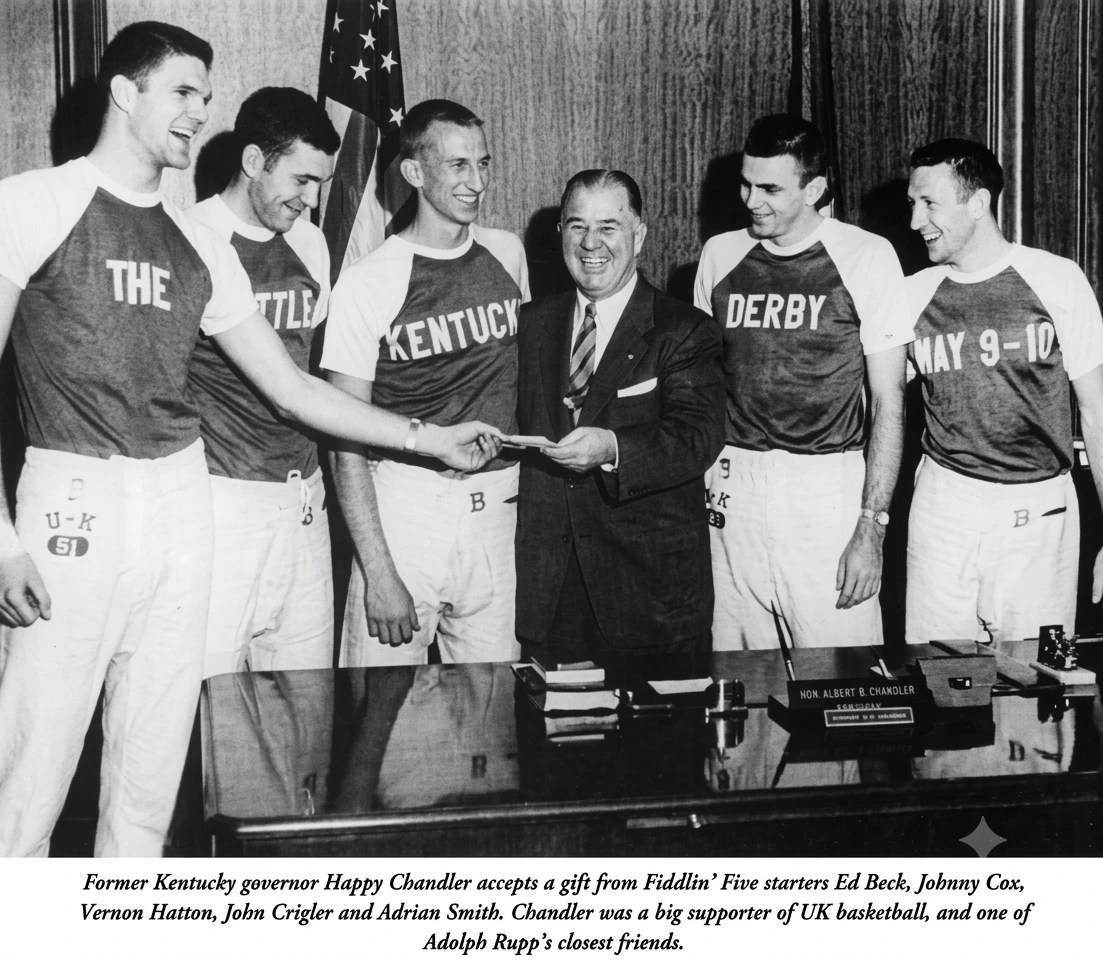
Kentucky’s 1957–58 basketball team became known as the Fiddlin’ Five, a nickname inspired by Adolph Rupp’s preseason doubts and the Wildcats’ habit of struggling before finding a way to win. Led by Vernon Hatton, Johnny Cox, John Crigler, Adrian Smith and captain Ed Beck, Kentucky finished 23–6, won the Southeastern Conference championship and captured the fourth NCAA title in program history.
The championship was one of the most unexpected of Rupp’s career. Kentucky entered the NCAA Tournament ranked ninth nationally after losing two of its final five regular-season games. The Wildcats nevertheless came together when it mattered most, advancing through the tournament and defeating Elgin Baylor and Seattle, 84–72, in the national championship game at Louisville’s Freedom Hall.
How the Fiddlin’ Five Got Their Name
Before the 1957–58 season, Rupp did not believe his team possessed the polished talent normally associated with a national championship contender.
“We’ve got fiddlers. That’s all. They’re pretty good fiddlers. Be right entertaining at a barn dance. But I’ll tell you—you need violinists to play in Carnegie Hall. We don’t have any violinists.”
The Wildcats reinforced that description throughout the season. They frequently played unevenly, fell behind or allowed opponents to remain close before producing a late run.
Rupp described them as “fiddlin’ around and fiddlin’ around, then finally pulling it out at the end.” The description stuck, and the team became known as the Fiddlin’ Five.
After Kentucky won the national championship, Rupp offered one final assessment:
“Those boys certainly are not concert violinists, but they sure can fiddle.”
The Fiddlin’ Five
| Player | Position | Height |
|---|---|---|
| Vernon Hatton | Guard | 6-3 |
| Adrian Smith | Guard | 6-1 |
| Johnny Cox | Forward | 6-4 |
| John Crigler | Forward | 6-3 |
| Ed Beck | Center | 6-6 |
The nickname referred primarily to Kentucky’s regular starting lineup, but the Wildcats’ championship required important contributions from the entire roster. Don Mills, in particular, played a major role during the NCAA championship game.
Vernon Hatton
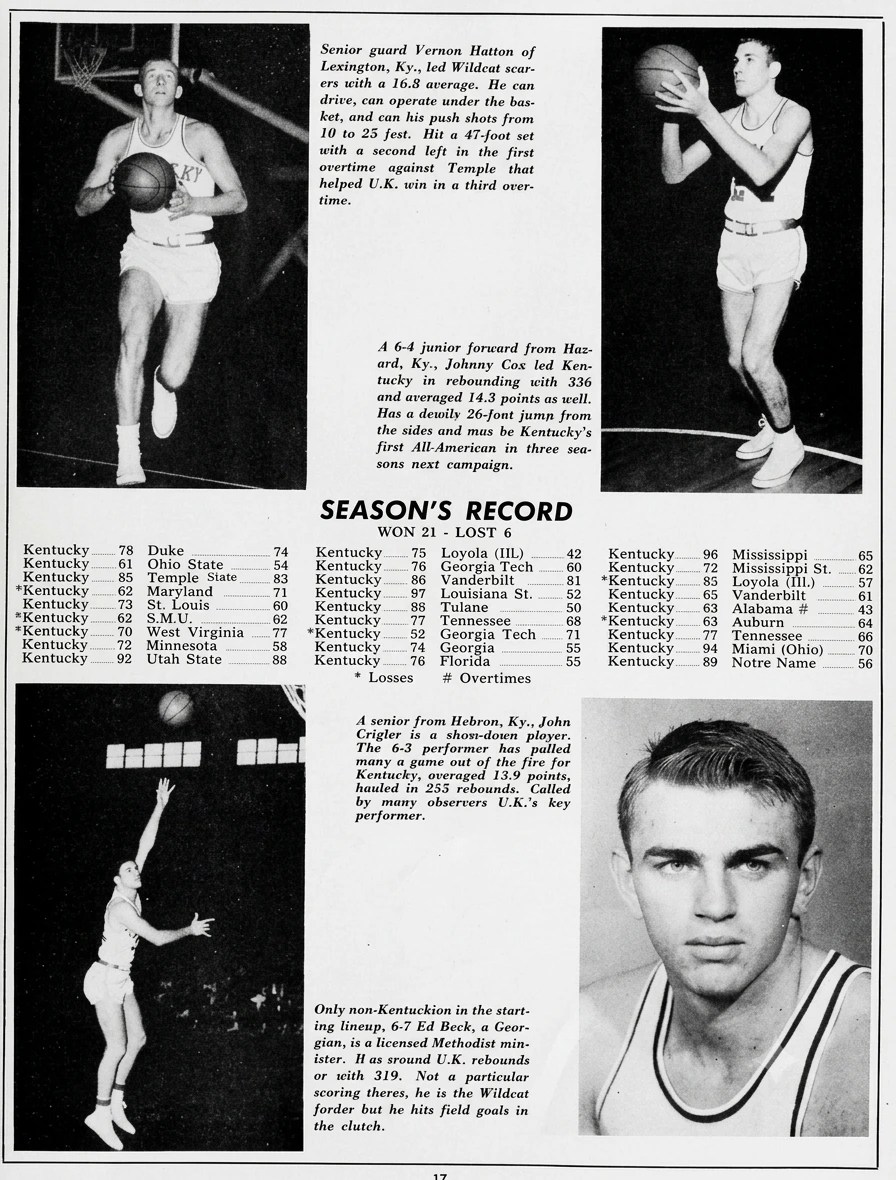
Vernon Hatton was Kentucky’s leading scorer and most dramatic performer. The Lexington native averaged 17.1 points per game and repeatedly delivered in critical situations.
His most famous regular-season moment came against Temple at Memorial Coliseum. With Kentucky facing defeat, Hatton made a 47-foot shot with one second remaining in overtime to force another extra period. The Wildcats eventually prevailed, 85–83, after three overtimes.
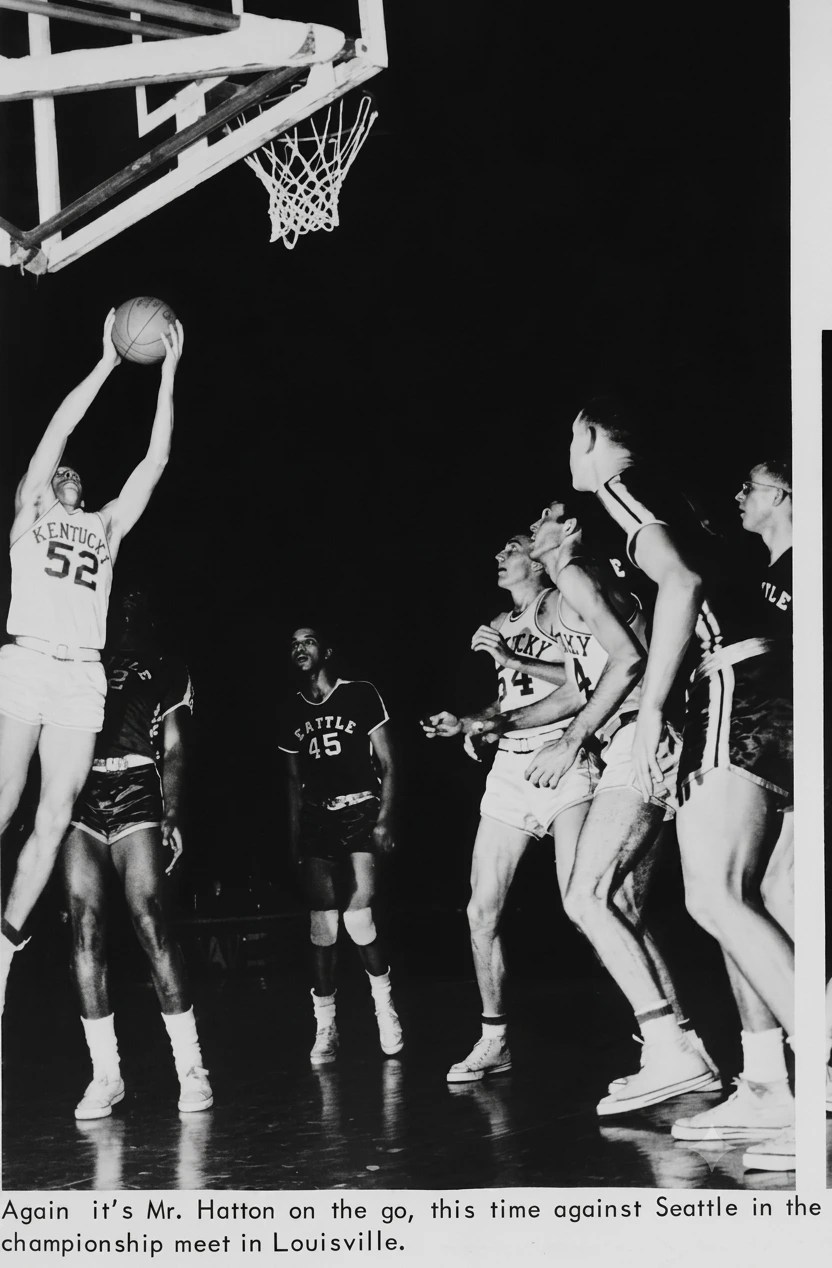
Hatton again became the central figure during the NCAA Tournament. He scored the winning basket in Kentucky’s 61–60 national semifinal victory over Temple and then produced 30 points against Seattle in the championship game.
His combination of scoring ability and late-game confidence made him the leading individual figure in Kentucky’s unexpected championship run.
Johnny Cox
Johnny Cox gave Kentucky an accomplished scorer and rebounder at forward. He averaged 14.9 points per game during the championship season and was one of the Wildcats’ most consistent offensive threats.
Cox played some of his finest basketball during the NCAA Tournament. He earned all-tournament recognition and scored 24 points in the championship victory over Seattle.
With Kentucky trailing for much of the title game, Cox helped lead the second-half comeback. His jump shot shortly after the Wildcats took their first lead extended the advantage and helped Kentucky seize control.
John Crigler
John Crigler provided scoring, rebounding and physical play along the front line. He averaged 13.6 points per game and gave Kentucky another dependable offensive option.
Crigler delivered one of his strongest performances in the national championship game, recording 14 points and 14 rebounds against Seattle. His work around the basket helped Kentucky withstand the presence of Elgin Baylor and complete its second-half rally.
Adrian Smith
Adrian Smith brought speed, ball handling and outside scoring to Kentucky’s backcourt. After beginning his college career at Northeast Mississippi Junior College, Smith transferred to Kentucky and became an important member of the championship lineup.
Smith averaged 12.4 points per game during the season and raised his production during Kentucky’s four NCAA Tournament games. His steady play helped balance a lineup that relied on contributions from several different scorers.
Smith later became an Olympic gold medalist and enjoyed a long professional career, but his rise to national prominence began as a member of the Fiddlin’ Five.
Ed Beck
Captain Ed Beck was the emotional and physical leader of the team. Although he was not one of Kentucky’s leading scorers, Beck provided rebounding, defense, toughness and experience.
Beck had served as a team captain during the previous season and again filled that role in 1957–58. His leadership became especially important as Kentucky navigated its inconsistent regular season and entered the NCAA Tournament without being considered the favorite.
His value could not always be measured through scoring totals. Beck helped hold the lineup together and provided the interior strength the Wildcats needed throughout their championship run.
The 1957–58 Season at a Glance
| Category | Result |
| Head coach | Adolph Rupp |
| Assistant coach | Harry Lancaster |
| Captain | Ed Beck |
| Overall record | 23–6 |
| SEC record | 12–2 |
| SEC finish | Champions |
| Final AP ranking | No. 9 |
| Final coaches ranking | No. 14 |
| NCAA Tournament | National champions |
| Championship opponent | Seattle |
| Championship score | Kentucky 84, Seattle 72 |
| Home arena | Memorial Coliseum |
View the complete 1957–58 Kentucky schedule and results
View the 1957–58 Kentucky roster
View the 1957–58 season statistics
An Unpredictable Regular Season
Kentucky opened the season with victories over Duke and Ohio State before facing Temple at Memorial Coliseum on December 7, 1957.
The Temple game provided an early example of the team’s unpredictable nature. The Wildcats needed Hatton’s remarkable 47-foot shot to extend the contest and finally escaped with an 85–83 triple-overtime victory.
View the Kentucky–Temple triple-overtime game
Kentucky then lost three of its next four games, falling to Maryland, Southern Methodist and West Virginia. The early defeats seemed to confirm Rupp’s concern that the team lacked the polished consistency of his earlier championship squads.
The Wildcats recovered and began conference play with victories over Georgia Tech, Vanderbilt, LSU, Tulane and Tennessee. They established themselves as the leading team in the SEC despite continuing to alternate between commanding performances and narrow escapes.
Kentucky suffered a 71–52 loss at Georgia Tech in late January but responded with another winning streak. The Wildcats ultimately completed conference play with a 12–2 record and captured the SEC championship.
There was no SEC Tournament during the 1957–58 season, so the regular-season title gave Kentucky the conference’s place in the NCAA Tournament.
An Unlikely Championship Contender
Kentucky did not enter the postseason with the appearance of a dominant team. The Wildcats lost two of their final five regular-season games and finished with six defeats overall.
They were ranked ninth in the final Associated Press poll and 14th in the coaches poll. Other teams entered the tournament with stronger records and higher national rankings.
Kentucky nevertheless possessed several qualities that became invaluable in tournament play. The Wildcats had experienced players, balanced scoring and a lineup that had spent the entire season surviving difficult situations.
Their tendency to “fiddle around” had produced inconsistency, but it had also taught them how to remain composed when a game was close.
The NCAA Tournament Begins in Lexington
Kentucky began the NCAA Tournament on its home floor at Memorial Coliseum against Miami of Ohio.
The Wildcats produced one of their most complete offensive performances of the season, defeating Miami, 94–70. The victory advanced Kentucky to the Mideast Regional championship game against Notre Dame.
View the Kentucky–Miami NCAA Tournament game
Kentucky was even more decisive against the Fighting Irish. The Wildcats won, 89–56, to capture the regional championship and advance to the Final Four.
View the Kentucky–Notre Dame NCAA Tournament game
The two victories represented a sharp contrast to the uneven team seen during portions of the regular season. Kentucky had won its first two tournament games by a combined 57 points and appeared to be playing its best basketball at precisely the right time.
A Rematch with Temple
Kentucky faced Temple in the national semifinal at Freedom Hall in Louisville. The teams had already produced a triple-overtime classic earlier in the season, and the rematch proved equally dramatic.
Temple held Kentucky to 61 points and remained within a possession during the closing seconds. With the Wildcats trailing, Hatton drove for a layup that gave Kentucky the lead with 17 seconds remaining.
The Wildcats protected the advantage and escaped with a 61–60 victory.
View the Kentucky–Temple national semifinal
Hatton’s winning basket sent Kentucky to the NCAA championship game for the first time since the Wildcats defeated Kansas State for the 1951 title.
Kentucky Against Elgin Baylor
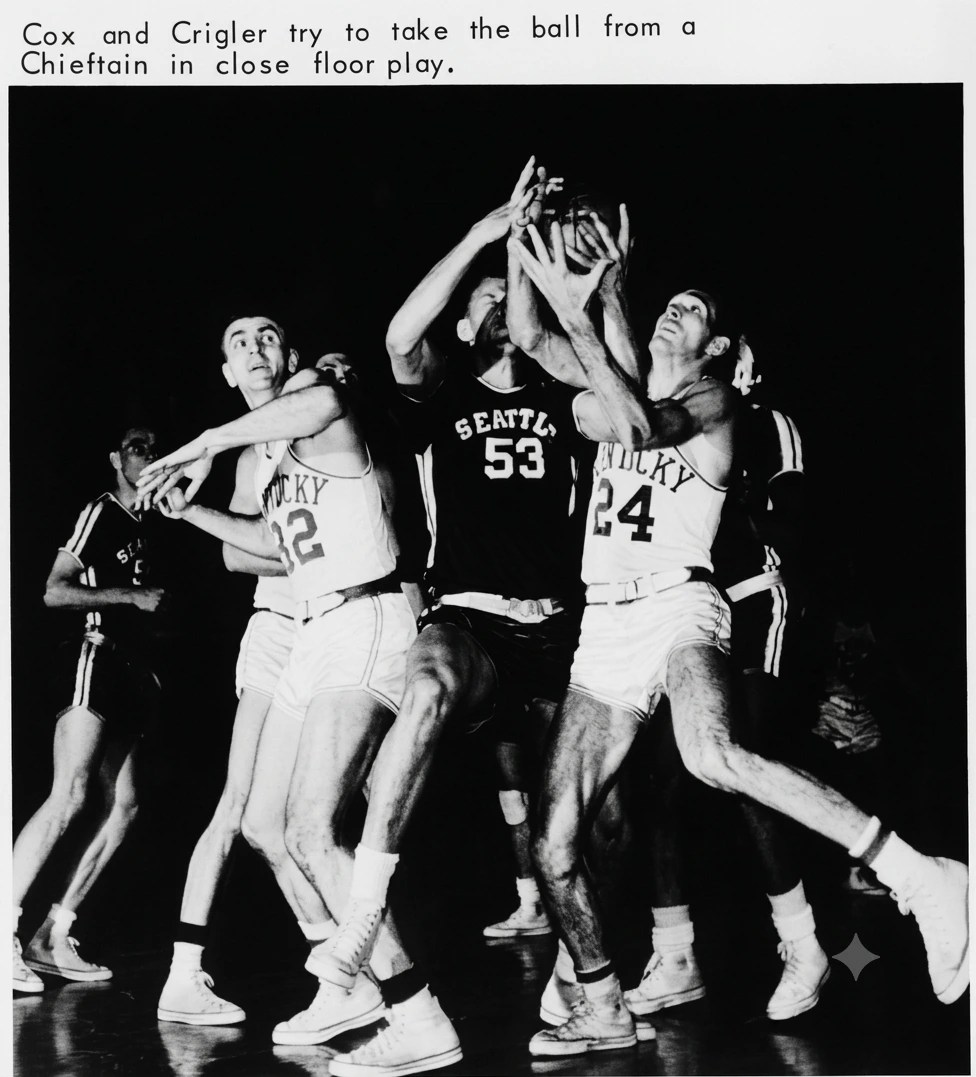
Seattle entered the championship game behind Elgin Baylor, one of the greatest players in college basketball. Baylor averaged more than 32 points per game during the season and presented Kentucky with its most difficult individual matchup.
The championship was played on March 22, 1958, at Freedom Hall before 18,803 spectators, then a record crowd for an NCAA final.
Seattle controlled much of the first half. The Chieftains built an 11-point advantage on two occasions and entered halftime leading Kentucky, 39–36.
The Wildcats remained behind for much of the second half. Seattle still held a 60–58 lead with approximately seven minutes remaining when Kentucky finally began its decisive run.
Don Mills made a hook shot that gave the Wildcats a 61–60 lead with 6:08 remaining. It was Kentucky’s first lead of the game. Cox followed with a jump shot, and the Wildcats never trailed again.
Hatton scored 30 points, while Cox added 24. Crigler finished with 14 points and 14 rebounds. Mills scored nine points, and Smith contributed seven.
Baylor led Seattle with 25 points and 19 rebounds before fouling out. Despite his performance, Kentucky pulled away during the closing minutes and won, 84–72.
View the Kentucky–Seattle championship game
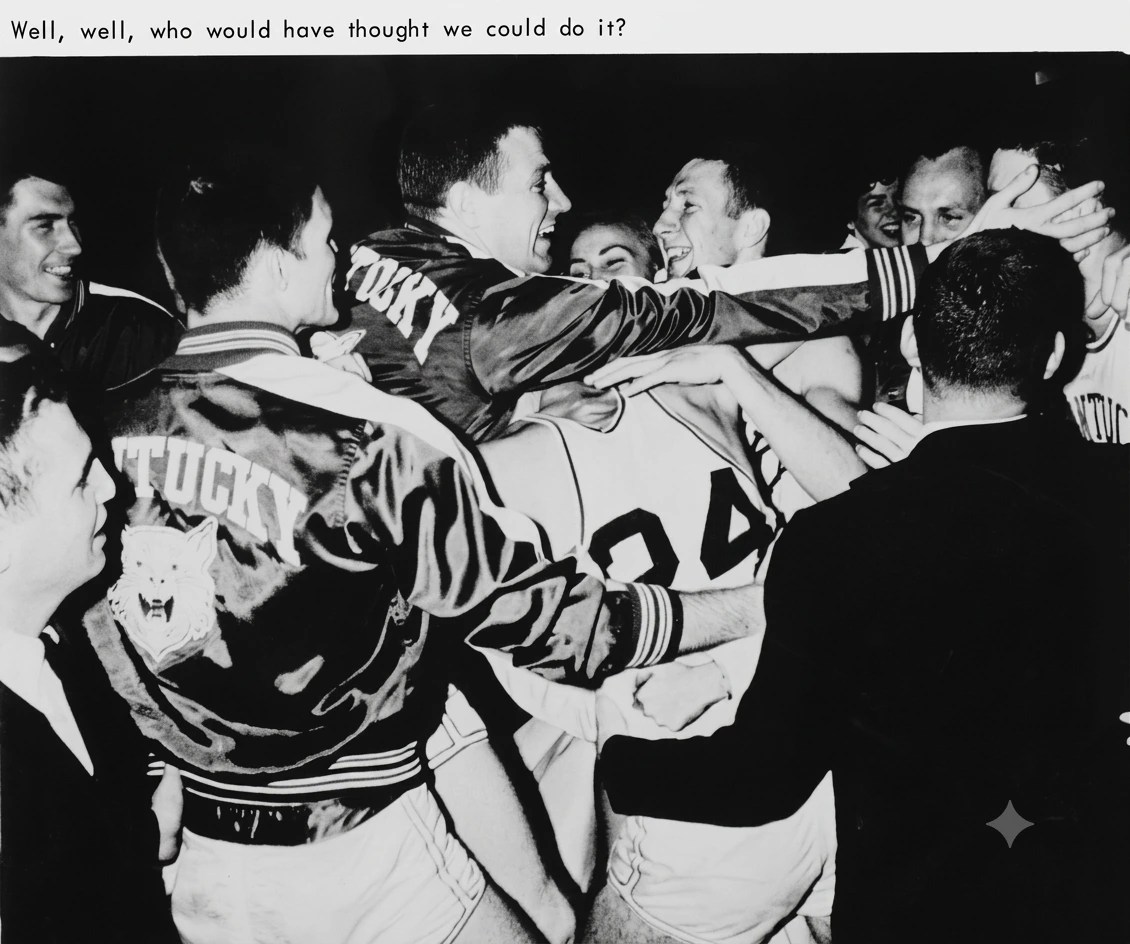
The victory completed a remarkable postseason transformation. A team that had entered the tournament with six losses and modest national expectations had become the NCAA champion.
Adolph Rupp’s Fourth Championship
The 1958 title was Kentucky’s fourth NCAA championship in 11 seasons. It followed the championships won by Rupp’s teams in 1948, 1949 and 1951.
It also proved to be Rupp’s final national championship. He continued coaching Kentucky through the 1971–72 season and led several later teams to deep NCAA Tournament runs, including Rupp’s Runts in 1966, but never again won the title.
The Fiddlin’ Five therefore occupy a distinctive place in Kentucky history. They were not considered Rupp’s most talented team, nor were they the most dominant. Their championship instead came through resilience, balanced scoring and an ability to survive close games.
The Supporting Cast
Although the starting five gave the team its nickname, Kentucky’s title was a complete team achievement.
Don Mills played a particularly important role in the championship game. His second-half hook shot gave Kentucky its first lead, and he finished with nine points against Seattle.
Other members of the championship roster included:
Assistant coach Harry Lancaster also remained an essential part of Rupp’s staff, helping prepare and develop a team that reached its peak during the NCAA Tournament.
Life After the Championship
Several members of the Fiddlin’ Five continued their basketball careers after leaving Kentucky.
Hatton was selected by the Cincinnati Royals in the 1958 NBA Draft and played four professional seasons. His jersey was later retired by Kentucky, and he became a member of the inaugural UK Athletics Hall of Fame class in 2005.
Cox was drafted by the New York Knicks and played professionally before beginning a successful coaching career. Kentucky also retired his jersey in recognition of his accomplishments.
Smith later served in the United States Army and won a gold medal with the United States at the 1960 Olympic Games in Rome. He played 11 professional seasons and was named the Most Valuable Player of the 1966 NBA All-Star Game.
Crigler was selected in the NBA Draft, while Beck entered the ministry and remained closely connected to Kentucky basketball and his championship teammates.
Their lives after Kentucky added to the enduring legacy of a team that had already secured its place in program history.
Their Lasting Legacy
The Fiddlin’ Five remain one of the most memorable teams of the Adolph Rupp era.
They were not a wire-to-wire national powerhouse. They lost six games, endured stretches of inconsistent play and entered the NCAA Tournament outside the country’s top five. Yet they defeated four tournament opponents, survived a one-point national semifinal and overcame an 11-point deficit against a Seattle team led by Elgin Baylor.
The nickname initially reflected Rupp’s belief that the Wildcats lacked the refined talent required to perform on college basketball’s grandest stage. By the end of the season, it represented something entirely different: a resourceful and resilient team that always seemed capable of finding the right tune before the final horn.
Kentucky’s 84–72 victory over Seattle delivered the program’s fourth national championship and ensured that the Fiddlin’ Five would forever be remembered among the Wildcats’ great teams of tradition.
Photo Gallery